
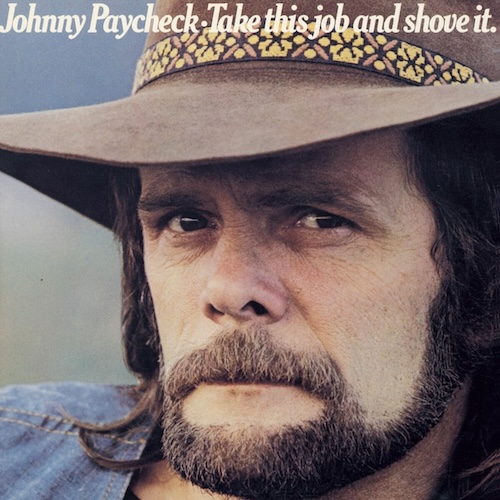
[Take This Job and Shove It album art | Download JPG]
Originally written by David Allan Coe, and produced by Billy Sherrill
LISTEN/SHARE/EMBED: YouTube | Spotify | Apple | Amazon
Johnny’s son John PayCheck carries forward his Father’s legacy through his own songwriting and live performances across the U.S.
Media Assets: jwamedia.com/johnny-paycheck
“…you can hear his creeping smirk; you can feel his slowly burgeoning elation…”
– Rolling Stone, The 200 Greatest Country Songs Of All Time
“…one of the country’s defining working-class anthems.”
– Russ Penuell, Billboard
“…became a cultural phenomenon in its own right.”
– Melanie Davis, American Songwriter
“…gone down as a staple of the genre.”
– Olivia Klimek, Parade
NASHVILLE, Tenn. (November 03, 2026) — Outlaw country pioneer Johnny PayCheck’s working class anthem “Take This Job & Shove It” celebrates the 49th release anniversary of the RIAA Platinum hit song. Originally released as a single on October 14, 1977, the recording became PayCheck’s signature hit, reaching No. 1 on Billboard’s Hot Country Singles chart for two consecutive weeks in January 1978 and spending 18 weeks on the chart overall. The song also reached No. 1 on Canada’s RPM country chart, transforming a blunt declaration of workplace frustration into one of the most recognizable expressions of blue-collar rebellion in American popular music.
Written by fellow outlaw country artist and songwriter David Allan Coe and produced by Nashville recording legend Billy Sherrill, “Take This Job & Shove It” arrived at a pivotal point in PayCheck’s career. Known for his gritty honky-tonk delivery, unconventional persona and uncompromising vocal style, PayCheck had already established himself as a formidable country recording artist with hits including “She’s All I’ve Got,” “Someone to Give My Love To” and “Slide Off Your Satin Sheets.” The 1977 release brought those qualities together in a recording that would ultimately eclipse his other hits in public recognition.
The song’s origins were as irreverent as its message. Coe wrote the composition, supplying a narrative about a working man whose dissatisfaction with his job is compounded by a troubled romantic relationship. PayCheck’s performance gave that frustration a combustible personality, turning the narrator’s final act of defiance into a moment of cathartic release. Sherrill’s production paired PayCheck’s rough-edged vocals with the precision of Nashville’s studio musicians, creating a record that balanced mainstream country craftsmanship with the rebellious spirit associated with the outlaw movement.
The song’s commercial success extended beyond the singles chart. PayCheck’s 1977 Epic Records album of the same name reached No. 2 on Billboard’s Top Country Albums chart and No. 72 on the Billboard 200, eventually earning Platinum certification. The single also earned PayCheck a GRAMMY® nomination for Best Country Vocal Performance, Male, at the 1979 Awards program.
In 2024, Rolling Stone ranked “Take This Job & Shove It” at No. 56 on its The 200 Greatest Country Songs of All Time list. The publication praised the performance’s emotional progression, observing that listeners can hear PayCheck’s “creeping smirk” and feel his “slowly burgeoning elation” as the song approaches its defiant conclusion. The magazine also ranked the album Take This Job and Shove It at No. 32 on its 100 Greatest Country Albums list, further recognizing the recording’s place in country music history.
The song’s legacy has continued to receive national attention. In August 2026, Parade revisited the hit’s history in a feature marking 49 years since its release, highlighting its chart success, Platinum certification and enduring place in country music. Billboard also revisited Coe’s songwriting legacy in May 2026, recognizing PayCheck’s recording as one of the defining working-class anthems in country music. These retrospective assessments reinforce the song’s significance not simply as a chart-topping single, but as a recording whose cultural reach has outlasted its original era.
Hollywood further cemented the song’s place in popular culture with the 1981 comedy film Take This Job and Shove It, directed by Gus Trikonis and starring Robert Hays, Barbara Hershey, Art Carney and David Keith. PayCheck made a cameo appearance during the film’s barroom fight scene, bringing the artist behind the anthem into the story it had inspired.
The song’s influence has also crossed genre boundaries. Willie Nelson performed it on his 1978 album Willie and Family Live, while punk rock band Dead Kennedys included a version on their 1986 album Bedtime for Democracy. A rap adaptation by Canibus featuring Biz Markie also appeared in the 1999 film Office Space, demonstrating the song’s adaptability beyond its country origins.
More than five decades later, the songs continue to resonate through live performances by John PayCheck – Johnny’s only son and respected country artist in his own right – who performs many of his father’s most beloved songs for audiences across the country, carrying forward the legacy of one of traditional country music’s most enduring voices.
About Johnny PayCheck:
Johnny PayCheck is considered by many within the country music industry and arts to be one of the founders of the outlaw country music movement during the 70’s. That said, his soulful sound and phrasing made him a legend amongst the honky-tonk crowd and his peers. Even to this day new fans are discovering the depth of his musical talent far exceeds “Shove it”. His musical career spanned over 40 years and included a massive catalog of songs and performances. His career was stained by his outrageous behavior at times, to the point that one music executive asserted they would make sure no one ever knew who Johnny PayCheck was in country music after a heated label meeting went off the rails.
His life after his mistakes proved to be one that showed he had learned some hard lessons and did his best to repair the damage which did earn him a home at the Grand Ole Opry and at Sony Music. A true honky-tonk legend, an outlaw musician, a constant reminder to pick yourself up after being knocked down and a husband and father which few saw outside his true friends and family. Johnny PayCheck was a side man that outshined many of his counterparts at times but could never get out of his own life lessons till it was too late in his life.
Present day you won’t find much said about Johnny PayCheck in the country music history books or historical documentaries. You won’t find a big exhibit honoring him in Nashville. You must look close to find where his mark was made on country music. His brass placard still hangs backstage at the Opry. You can find autographed pictures still remaining at Tootsies and the Ernest Tubb Record Shop. You can find his “Shove It” guitar at the Country Music Hall of Fame along with a few of his gold records. For the most part though, it is the fans who keep his music and memory alive while an industry still profits from the entertainer they would rather forget.
His peers would come from backstage and stand in silence just to hear him sing “Old Violin.” Today those same peers will tell you how they loved him and how he was an amazing vocalist and writer. It is an industry that has forgotten, not the fans or the musicians he worked alongside. Some leave him out of the pages of history due to his controversial missteps, others don’t know his history even though his name reappears constantly alongside his peers that were more careful with their careers, but Johnny PayCheck is still a musical force to take notice of even today.
# # #